


Graphic design career change: which training courses should you choose to get started?
Share
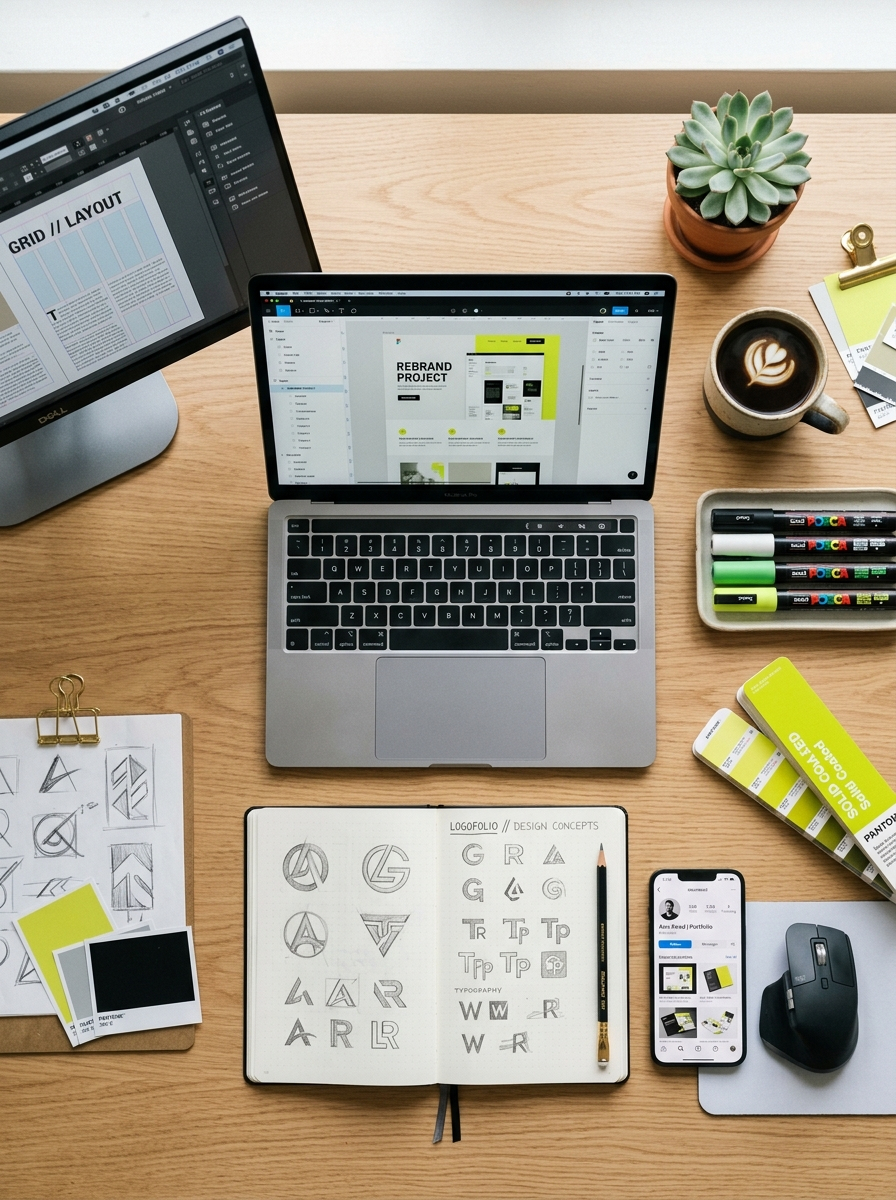
Graphic design career change: which training courses should you choose to get started?

Changing careers to become a graphic designer attracts thousands of French professionals every year. Visual communication has become ubiquitous—social media, e-commerce, apps, print media, signage—and the demand for creative professionals is growing. But between short courses selling for €800 online and Bachelor's degrees costing €9,000 a year, choosing the right path for a graphic design career change is rarely straightforward . This guide reviews the real options available, their duration, cost, and the profiles they suit. The goal: to avoid wasting 12 months and several thousand euros on training that doesn't lead to a job.
The graphic designer profession today: what has changed
The graphic designer creates visual communication materials for brands, media outlets, institutions, and individuals. Logos, posters, websites, visual identities, packaging, social media content : their scope has expanded considerably in ten years.
Digital technology has transformed the profession. Where a graphic designer primarily printed brochures in 2010, they now produce mainly for digital media —animated formats, multi-platform adaptations, and designs tailored to different channels. This evolution explains why recruiters are now looking for versatile profiles, capable of switching between print, web, and motion graphics. For a comprehensive overview of the sector, the article on design careers details the various possible specializations.
The expected technical skills
- Proficient in Adobe Creative Suite: Photoshop, Illustrator, InDesign
- Figma basics for interface design
- Solid understanding of typography, colorimetry and composition
- Ability to understand a client brief and justify one's choices
- Regular creative monitoring and broad visual culture
The arrival of generative AI hasn't eliminated the profession, but it has reshaped the landscape. Graphic designers now use Midjourney, DALL-E, or Adobe Firefly to iterate more quickly through the exploration phases. The added value is shifting towards art direction, conceptual understanding, and long-term brand consistency —areas where AI remains limited.
Why graphic design is a good career change option in 2026
Three reasons make graphic design an attractive career change.
First, the market remains active . Graphic design is among the creative professions that recruit most regularly: communication agencies, corporate communications departments, startups, e-commerce businesses, local authorities, and media outlets. Demand has even accelerated with the rise of visual content on social media platforms and the development of online commerce.
Next, there's the flexibility of the profession . You can work in an agency, in-house at a company, or as a freelancer. Nearly one in three graphic designers works independently, according to INSEE data—a status that allows for a gradual career change and initial clients without a complete interruption in income.
Finally, accessibility . Unlike professions restricted by a state diploma, the graphic design profession is not regulated. Recruitment is determined by actual skills and portfolio. A well-managed career change can therefore lead to employment in less than 18 months , even without prior design experience.
Which training courses should you choose based on your profile?
Three types of training exist for a career change to graphic design . None is universally better: it all depends on your starting point, your budget, and the time you can dedicate to the project.
Short courses (3 to 12 months): for whom?
Short courses target working professionals who want to quickly develop their skills without interrupting their work . They focus on mastering tools — Photoshop, Illustrator, InDesign — and producing initial concrete projects.
- Duration: 3 to 12 months, often online or in evening classes
- Cost : €500 to €4,000 depending on the organization
- Public: retrained with a creative background or a specific project (for example, moving from communications officer to in-house graphic designer)
- Limit : A degree alone is not always enough to convince a demanding recruiter — a portfolio becomes the real key piece of evidence.
Concrete examples: RNCP level 5 professional qualifications, short courses in continuing education (Gobelins, Pyramyd, EMI-CFD), online courses with mentoring.
Bac+2 to Bac+5 degrees: resuming studies
For those who want a real upgrade and a recognized diploma, several options exist in the traditional French system.
- Master's degree (Bac+2): BTS Graphic Design, DMA Graphic Arts — two years of in-person instruction
- Master's degree (Bac+3): DN MADE with a specialization in graphic design, Professional Bachelor's degree in Graphic Design, Bachelor's degree from a private school — three years
- Master's degree (Bac+5): DSAA Design with a specialization in graphic design, Master's degree from an art school — four to five years combined
These programs are longer and more expensive, but they award a diploma registered with the RNCP (National Directory of Professional Certifications), which is recognized by employers . According to France Compétences , 52% of graphic designer job offers require a minimum of two years of post-secondary education (Bac+2), thus justifying the initial investment.
Schools specializing in graphic design
For adults seeking immersive training and a professional network, specialized private schools offer dedicated programs. This is the path chosen by those aiming for a complete career change: access to active professional instructors, real client projects from the first year, the option of work-study programs in the second and third years, and individualized portfolio development.
For example, Intuit Lab offers a three-year Bachelor's degree in graphic design , with admission open to career changers. The courses combine artistic fundamentals (drawing, typography, visual culture) with practical experience on projects commissioned by real brands.
| way | Duration | Cost | Qualification | Ideal profile |
|---|---|---|---|---|
| Short training | 3 to 12 months | 500 to 4 € | RNCP level 5 qualification | Reconverted with a creative base |
| BTS / DN MADE | 2 to 3 year-olds | Free (public) to €5,000/year | Bac+2 or Bac+3 recognized | Resuming traditional studies |
| Bachelor's degree from a private school | 3 years | 7 to 000 €/year | Bachelor's degree (Bac+3) RNCP | Complete change + network |
| Master's / DSAA | 4 to 5 year-olds | 8 to 000 €/year | Bac + 5 | Target position: DA / management |

Distance learning, in-person learning, or blended learning: which to choose?
The training format influences success as much as the program content. Each has its own constraints.
Distance learning is suitable for independent learners who already have a structured learning routine. It allows you to continue working while studying, but it requires rigorous organization. Many adults drop out along the way due to a lack of regular support. If you choose this option, check for the availability of synchronous virtual classes and individual follow-up —not just pre-recorded videos.
In-person training offers a fully immersive experience: workshops, group feedback sessions, peer interaction, and access to equipment. It's the most time-consuming format (generally five days a week), but also the one that produces the best portfolios . It's designed for full-time career changes funded by CPF + AIF, or through a negotiated resignation with a mutual termination agreement.
Apprenticeships combine the best of both worlds. You spend part of your time in school (often two weeks a month) and the rest of your time working for a company. This offers three key advantages: you get paid, you gain practical experience, and the company finances your training through the apprenticeship tax. The challenge: finding a host company, which requires at least a basic portfolio and a clear career plan.
Good to know for those over 30: apprenticeships remain accessible through professional training contracts (with no age limit) and the Pro-A program for employees on permanent contracts. These programs are often overlooked, even though they are specifically designed for career changes.
How much does it cost to retrain as a graphic designer and how can you finance it?
The total cost varies from €1,000 for a short course to over €30,000 for a full program at a private school. Several schemes cover all or part of these costs.
The Personal Training Account (CPF)
The CPF (Personal Training Account) credits your training entitlements each year you work. A full-time employee can accrue up to €500 per year, capped at €5,000 . Most RNCP-registered graphic design qualifications are eligible. Check on your Mon Compte Formation account that your chosen training provider is listed, and allow at least 11 days between registration and the start of your course.
Individual Training Assistance (AIF)
The AIF (Individual Training Assistance) from France Travail is for job seekers . It can cover all or part of the remaining costs after the CPF (Personal Training Account) has been used. Applications are submitted through your France Travail advisor and require a previously approved career plan. Allow 4 to 8 weeks for processing.
alternating
Apprenticeships are virtually free for the apprentice : the company finances them through the apprenticeship tax, and you receive a salary (from 27% to 100% of the minimum wage, depending on your age and previous education level). It's the least expensive option for a long-term career change.
The Professional Transition Project
The PTP (formerly CIF) allows employees on permanent contracts to finance long-term training while maintaining part of their salary . Conditions: a minimum of 24 months of employment within the last five years, including 12 months with the current employer. Applications should be submitted to Transitions Pro in your region.
Regional aid
The Île-de-France and Provence-Alpes-Côte d'Azur (PACA) regions offer specific support for career changes into creative professions. Amounts and conditions vary—contact your regional council or a Career Development Advisor (CEP) for more information; this service is free.
Practical advice: allow 3 to 6 months for administrative procedures between the decision to change careers and the actual start of training. This is the phase most underestimated by candidates.
What career opportunities and salaries are available after the training?
Graduates of a graphic design course can be divided into three main paths.
In an agency or studio
Available positions: junior graphic designer, junior motion designer, assistant art director. Starting salary: €2,200 to €2,600 gross per month in the Paris region , €1,900 to €2,200 in other regions. Career progression within three to five years leads to art director positions (€3,500 to €5,000 gross), with team management responsibilities.
Internally within a company
Available positions: in-house graphic designer, product designer, web designer (see detailed job description), visual communication officer. Salaries are often slightly higher than at agencies for equivalent skills, but with less project variety. A good option for those seeking stability, work-life balance, and funded continuing education.
Freelance
This status is chosen by approximately 30% of working graphic designers . The average daily rate (ADR) for a beginner ranges from €200 to €300, rising to €500-€700 for a recognized senior professional. Beware of a common pitfall: underestimating non-billable time (prospecting, administrative tasks, continuing education), which easily represents 40% of actual workload.
The most in-demand specializations in 2026 are: UX/UI design, motion design, strategic branding, and mobile app interface design . A career change from graphic designer to graphic designer , well-suited to these niches, will significantly improve your chances of being hired after completing your training.
Are you considering a career change to graphic design?
The Intuit Lab school in Paris welcomes career changers each year to its Bachelor of Graphic Design program, with admission based on application and interview. Work-study options are available from the second year.
F.A.Q
How long does it take to retrain as a graphic designer?
From 6 months for a short, software-focused training program to 3 years for a full Bachelor's degree in design school. The average for adults changing careers is around 12 to 18 months, the time needed to acquire the fundamentals, build a credible portfolio, and find a first job.
Is it possible to become a graphic designer without a degree?
Yes, the profession isn't regulated. But according to France Compétences, 52% of job offers require at least a two-year post-secondary degree. Without a degree, your portfolio needs to be particularly strong, and you'll likely have to start with freelance work or short-term assignments before securing a salaried position.
What is the salary of a beginner graphic designer?
A junior graphic designer earns an average of €2,200 gross per month at the start of their career, and up to €2,600 in the Île-de-France region. After 5 years of experience, the average salary rises to €3,000-€3,500 gross. As a freelancer, the starting daily rate is around €250 per day, excluding social security contributions.
Does the CPF cover all graphic design training?
The CPF (Personal Training Account) fully covers short courses (under €5,000) if you have sufficient funds. For longer courses such as a Bachelor's degree, you generally need to supplement it with AIF (Individual Training Assistance), a PTP (Professional Transition Project), personal funding, or opt for an apprenticeship. Apprenticeships remain the least expensive option for the learner.
Do you need to know how to draw to become a graphic designer?
Knowing how to draw helps but isn't essential. Digital tools allow you to produce professional visuals without mastering traditional drawing. However, visual literacy, a sense of composition, and an understanding of typographic conventions are indispensable—and these are acquired through formal training.
Which design school should I choose for a career change in Paris?
Several private schools in Paris accept students seeking a career change, with admissions based on application and interview. Key criteria for selection include: RNCP certification of the diploma, a high job placement rate within six months, the quality of the instructors who are active professionals, and the availability of a work-study program starting in the second year.
Will AI replace graphic designers?
No, but it's redefining the profession. Graphic designers are now using Midjourney, DALL-E, or Adobe Firefly to iterate faster through the exploration phases. Human value is shifting towards art direction, concept development, and brand consistency over time—areas where AI remains very limited.